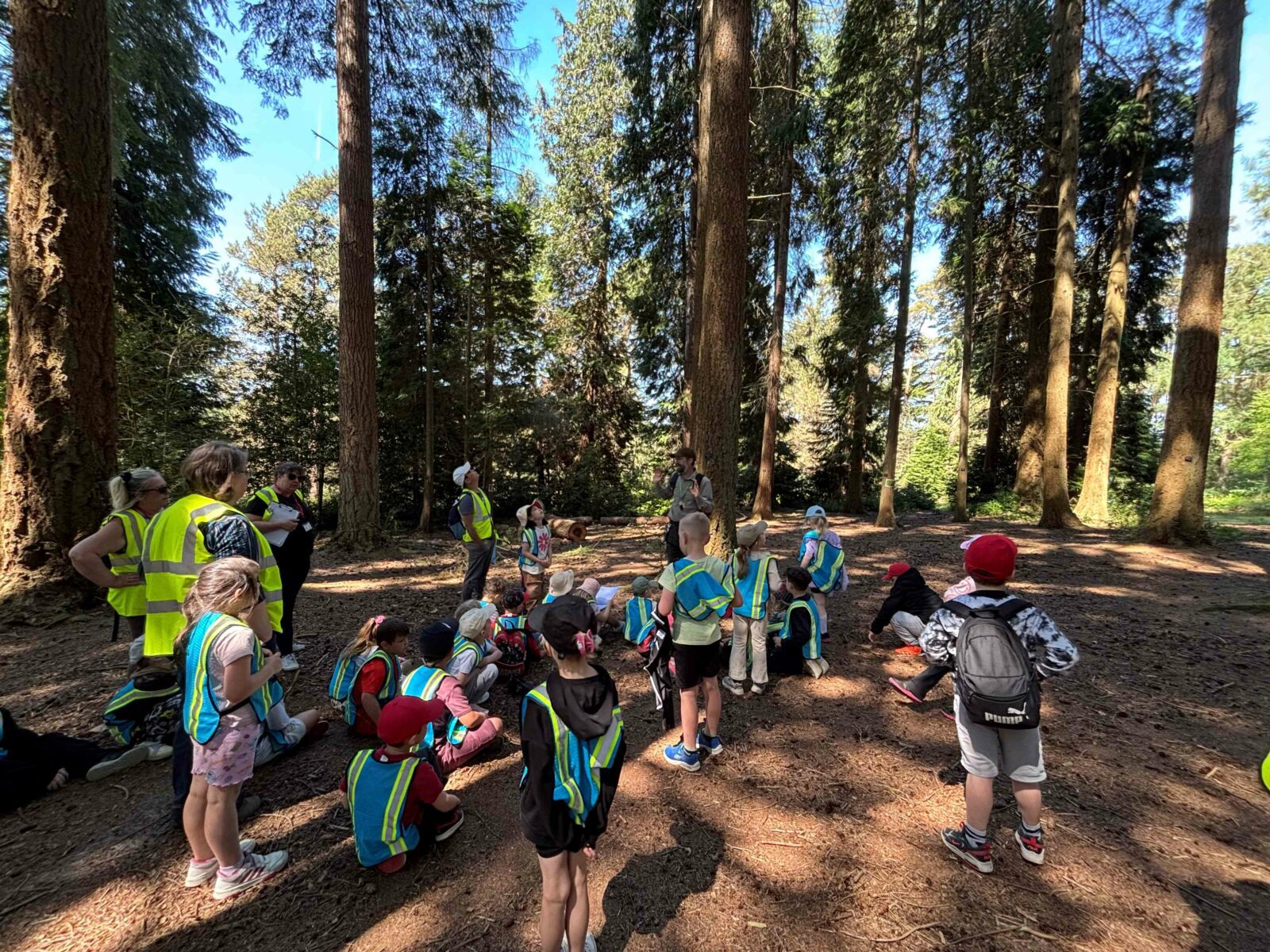
Bedgebury Education Visits
Kent High Weald Partnership are Forestry England’s delivery partner for school education visits at Bedgebury Pinetum in West Kent.
Bring your students to the beautiful Pinetum to enjoy, explore and learn about amazing trees, habitats, navigation, and nature! Details and booking information are below but please feel free to email us with any questions at cmp@khwp.org.uk.
Education Visit Information
Prices
Our standard education sessions last approximately 2.5 hours and can take place in either the morning or afternoon.
- Up to 30 children: £200
- Up to 60 children: £340
This includes:
- One KHWP leader per class of up to 30 children
- Visiting teaching staff, group leaders and helpers attending free of charge
- Free parking for coaches and minibuses
If a programme requires more than one KHWP leader per class, an additional charge of £100 will apply.
We ask that classes are organised into smaller groups of 5–6 children before arrival, with an accompanying adult responsible for each group.
Approximate Timings
Workshops for one class of up to 30 children
Arrival: 9:30am–10:00am
Session: 10:00am–12:30pm
Workshops for two classes of up to 60 children
Arrival: 9:30am–10:00am
Session: 10:00am–12:30pm
For two-class bookings, the trails will run at the same time using different routes. One KHWP leader will be assigned to each class.
Full-Day Visits
For an all-day experience, we can run two programmes: one before lunch and one after lunch. Please contact us to discuss your requirements.
Groups of More Than 60 Children
For groups of more than 60 children, please contact us by email before booking.
Groups of over 60 children are charged at £520 to reflect the additional logistics and staff time required to support larger visits.
Our Education Programmes
1. Discover our Pinetum
Recommended for Year R & 1
Find out more about the trees, plants and animals of Bedgebury. Children will explore, discover and experience: conifers/evergreen and deciduous trees, amazing cones, the wildlife of Bedgebury (trees, plants and animals), forest art and collecting natural treasures.
This programme will help you to meet parts of the following National Curriculum objectives: Year 1, Science (Plants; Animals, including humans).
2. Explore the Habitats of Bedgebury
Recommended for Year 2 & 3
Find out what lives amongst our trees and where they like to make their homes. Children will explore, discover and experience: conifers/ evergreen and deciduous trees, amazing cones, what animals and plants need from a home, the variety of habitats that Bedgebury offers and the interdependence of living things.
This programme will help you to meet the following National Curriculum objectives: Year 2, Science (Living things and their habitats; Animals including humans)
- Explore and compare the differences between things that are living, dead, and things that have never been alive.
- Identify that most living things live in habitats to which they are suited and describe how different habitats provide for the basic needs of different kinds of animals and plants, and how they depend on each other.
- Identify and name a variety of plants and animals in their habitats, including micro-habitats.
- Describe how animals obtain their food from plants and other animals, using the idea of a simple food chain, and identify and name different sources of food.
- Notice that animals, including humans, have offspring which grow into adults.
- Find out about and describe the basic needs of animals, including humans, for survival (water, food and air).
3. From Tiny Seeds to Mighty Trees
Recommended for Year 3 & 4.
What is a tree and how does it grow? Discover the functions of plant / tree parts and learn about what they need to grow. Children will explore, discover and experience: conifers/ evergreen and deciduous trees, amazing cones, tree rings, tree parts and functions and the requirements for growth.
This programme will help you to meet the following National Curriculum objectives: Year 3, Science (Plants; Animals, including humans)
- Identify and describe the functions of different parts of flowering plants: roots, stem / trunk, leaves and flowers.
- Explore the requirements of plants for life and growth (air, light, water, nutrients from soil, and room to grow) and how they vary from plant to plant.
- Investigate the way in which water is transported within plants.
- Explore the part that flowers play in the life cycle of flowering plants, including pollination, seed formation and seed dispersal.
4. Map Quest
Recommended for Year 2 – 7.
Make your own early navigation device: ‘map stick’ and take a walk through our trees from around the world. Use it to make and retrace a route using geographical language on the way. Learn to use a simple map and identify key features. Children will explore, discover and experience: conifers/ evergreen and deciduous trees, amazing cones, trees from around the world, a basic map, physical features, directional and geographical language. For Years 4 and above, children will use grid references and compasses.
This programme will help you to meet the following National Curriculum objectives: KS1 and 2 Geography
- Geographical skills and fieldwork (KS1) – Use simple compass directions (North, South, East, West) and locational and directional language (e.g. near, far, left, right) to describe the location of features and routes on a map. Use a simple map and use basic keys.
- Geographical skills and fieldwork (KS2) understand the navigational concepts of North, North East, South, South East etc